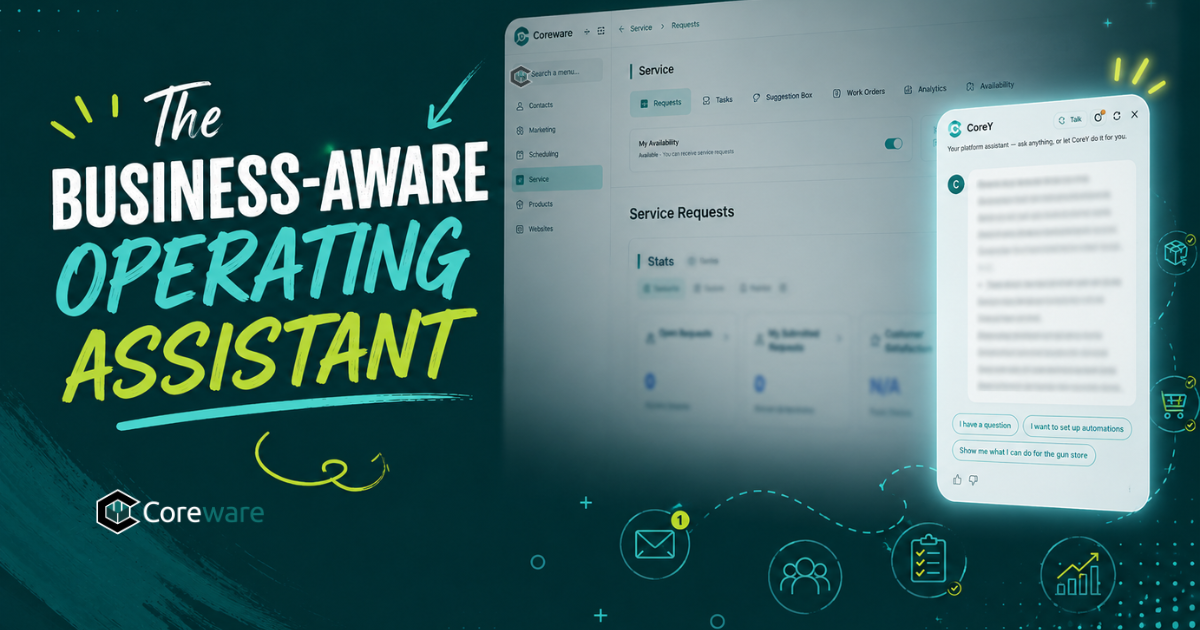
The Business-Aware Operating Assistant
Imagine showing up to work, sitting down at your computer, and getting ready to look over yesterday’s sales, inventory movement, purchase needs, employee performance, customer activity, and the products that should probably be featured in your next promotion.
Now imagine doing that without opening five reports, exporting three spreadsheets, clicking through ten screens, or trying to remember where the information lives.
Instead, you just ask.
Instead of digging through reports, spreadsheets, and different screens, you could simply ask your business what happened yesterday and what needs attention today. You could look at sales, low-stock items, fast-moving products, stale inventory, reorder needs, employee performance, and even which products should be grouped together for a collection, email, or website page, all through a more natural conversation with the system that already holds that information.
That is where retail is heading, and for the independent retailer, that is a much bigger shift than most people realize.
A business owner already has the answers sitting inside the business. Sales history, inventory movement, customer activity, employee performance, product data, and purchase history are all there, but too often that information is scattered across different screens, reports, spreadsheets, exports, and workflows. Instead of being able to see the business clearly, the owner or manager has to stop what they are doing, hunt down the information, piece it together, interpret what it means, and then decide what to do next.
That may work when things are slow, but most retailers are not operating in some perfect world where they have three quiet hours every morning to analyze the business. They are dealing with customers, employees, vendors, distributors, compliance responsibilities, website updates, marketing, purchasing, receiving, transfers, special orders, classes, memberships, and everything else that lands on the counter before lunch.
A business-aware operating assistant changes that relationship with the business because it gives the owner a faster way to understand what is happening and what needs attention.
Think about a retailer named John. He walks into the store in the morning and already knows the day is going to be busy. The weekend is coming, customers have been asking about certain products, a few staple items have been moving faster than expected, and there are several purchase decisions that need to be made before the end of the day. In the old way of working, John would have to pull up reports, scan inventory levels, check reorder points, compare what sold recently, look at what has been sitting, and then start making decisions.
With a business-aware operating assistant, John can begin with a conversation.
He can ask, “What items sold last week that are now below the quantity I should keep in stock?”
That question would normally require him to know which report to run, how to filter it, how to compare sales against current inventory, and how to translate that into action. When the system understands the business, that question becomes something John can ask in plain language.
That sounds simple, but it is not small. For a retailer, simple is powerful when it saves time, removes guesswork, and helps the owner act before the problem shows up at the worst possible moment.
John can ask which items are moving fast over the last thirty days, then look at what is below the reorder point and what needs to be purchased. He can see which products are critical, which products are dead stock, and which products are tying up cash that could be working somewhere else. This is important because inventory is one of the most important parts of the business. The wrong inventory sits. The right inventory sells. Too little inventory costs sales. Too much inventory traps money on the shelf. A good retailer understands this, but understanding it and keeping up with it every day are two very different things.
This is where the operating assistant starts to feel less like software and more like the business finally becoming aware of itself.
The business already contains the story of what is happening across the store. Sales, inventory levels, receiving, adjustments, stale products, reorder needs, supplier options, minimum stock levels, and overbuying risks are all part of the same picture. When that information is connected and easy to question, the retailer can stop guessing and start making decisions based on what the business is already showing them. When that information becomes conversational, the owner is no longer forced to hunt for every answer manually, but instead can steer the business with questions.
It’s important to understand this distinction. The assistant should not replace the operator. The owner still makes the call. The manager still uses judgment. The team still decides what fits the season, the market, the customer base, and the cash position of the business. The value is that the assistant can bring the right information to the surface faster, so the decision is based on what is actually happening instead of what someone thinks might be happening.
A smart purchasing workflow is one of the clearest examples. John may have a staple item he always wants in stock, and the system can help him recognize when it falls below the level he wants to maintain. From there, he can review the suggested quantity, choose a supplier, and create a purchase order. As the system gets smarter, that process becomes less about digging and more about reviewing. John is still in control, but the work gets compressed from a long manual process into a much faster decision. That is a major advantage because independent retailers do not need more busywork. They need better visibility, better decisions, and faster action.
The same idea applies to sales reporting. John should not have to know the exact path to a specific report every time he wants to understand something about the business. He should be able to ask for a sales performance report by employee and get something useful. He should be able to ask how sales looked yesterday, which categories are moving, which employees are producing, and which parts of the store need attention. Reports still matter, but the future is not forcing every owner to become a report builder before they can understand their own company. The future is being able to ask the business directly.
Marketing is another area where this becomes extremely valuable. Most retailers say they want more online sales, more repeat business, and more customer engagement, but many of them still send the same message to everyone. That usually means customers receive promotions that do not match what they care about. A customer who buys ammunition regularly may not care about the same email as someone who just purchased a pistol, booked a lane, signed up for a class, or bought a membership.
A business-aware operating assistant helps make the data useful because the business is already full of buying signals. Customer purchases, lane bookings, current inventory, product collections, and audience behavior all give the retailer a clearer picture of what people care about and what should be put in front of them next. When that information is connected, it becomes much easier to build smarter audiences, send better emails, feature the right products, and create displays that match actual customer behavior instead of guesswork.
John does not need to spend half a day building a simple product promotion from scratch. He should be able to pull products or collections into an email, send that email to the right audience, review whether the subject line is strong enough, and schedule it for a better send time. The point is not to send more random email. The point is to use the business data already sitting inside the system to show customers something they are more likely to care about.
That is where many retailers leave money on the table. The products, customers, purchase history, and buying signals are already there, but the value is often trapped because those pieces are not connected in a way that makes action simple. When the system can bring that information together, a campaign no longer has to feel like a manual project every time the retailer wants to put the right products in front of the right people.
Product collections are another example. A retailer may want a collection of in-stock pistols, products under a certain price, range memberships, or products that fit a certain promotion. A more capable assistant can help build those collections from instructions, and once those collections exist, they can feed into the website, emails, and other customer-facing areas. Over time, the more interesting opportunity is asking the business what products tend to go together, what items are commonly purchased in the same journey, and what collections make sense based on actual behavior rather than guesswork.
That is the kind of thinking retailers need more of. Too many stores still treat their website, email, POS, inventory, and customer data like separate islands. The future belongs to the retailer who can connect those pieces and act on what the business is already telling them.
The business-aware operating assistant can also reach beyond sales and inventory. Employee management, time off, training, onboarding, customer journeys, forms, waivers, memberships, classes, and other operational processes all become stronger when they live inside a system that can guide the work. A retailer should be able to create an employee onboarding journey that includes training steps, signed documents, forms, and required materials. A range should be able to guide a customer through a class, membership, or waiver process. A store should be able to track steps that otherwise get scattered across paper, emails, sticky notes, and memory.
Businesses do not usually break because of one big failure. They usually struggle because dozens of small things get missed, delayed, repeated, forgotten, or handled differently depending on who is working that day. A good operating system brings those pieces together. A business-aware operating assistant helps the owner understand and manage those pieces faster. That is why this vision is so important.
The retailer of the future will not win by staring at more spreadsheets. The retailer of the future will win by asking better questions, seeing the answers faster, and acting with more confidence. They will know what is moving, what is sitting, what needs to be reordered, what should be featured, what customer groups should be contacted, what employees are producing, what processes need attention, and what parts of the business are creating opportunity.
John’s workday changes because he is no longer just operating software. He is having a conversation with the business he built.
In the morning, he can sit down and get a clear picture of what happened yesterday, what needs attention today, which inventory is creating risk, which products should be promoted, what reports would be useful, and which items belong together in a collection. Instead of waiting until the end of the month to figure out where the business has been, he can start the day with a better understanding of where the business is moving. The business is already speaking through sales, inventory, customer behavior, employee activity, and operational patterns. The question is whether the retailer has a system that can help translate all of that into something useful.
If this interests you, Coreware can help.
What we covered here is already possible in important ways, and every day CoreY is getting smarter and more capable. Coreware is leading the charge to give retailers a business-aware operating assistant that can help answer questions about inventory, sales, purchasing, reports, product collections, marketing, employee management, customer journeys, and the operational work required to run a modern retail business.
Coreware is providing something that goes far beyond a traditional business solution. It is giving retailers a business-aware operating assistant that helps them understand, manage, and act on what is happening across the business. This is one of the most advanced solutions in the industry, and it is getting better every day.
To learn more, visit coreware.com.