The Coreware Blog
Stay updated with the latest industry insights, practical advice, and expert opinions to help you stay ahead.
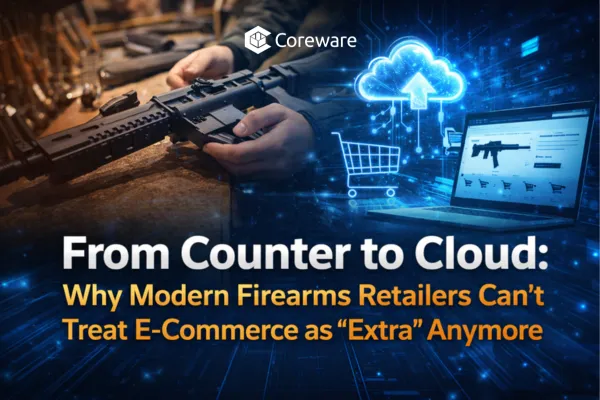
From Counter to Cloud: Why Modern Firearms Retailers Can’t Treat E-Commerce as “Extra” Anymore
For decades, firearms retail has been built at the counter. Relationships were forged face-to-face. Knowledge was shared in person. Trust mattered, and still does. For many retailers, the idea of selling firearms or regulated items online once felt unnecessary, or even counterproductive.
That mindset made sense for a long time.
But today, something important has changed. Even though the transaction still ends at the counter, the customer journey often starts somewhere else entirely. And increasingly, that “somewhere else” is online.
This isn’t about chasing trends, abandoning what works, or turning a gun store into a tech company. This is about recognizing how customer behavior has evolved, and understanding why treating e-commerce as an “extra” is creating more friction than most retailers realize.
The Modern Customer Journey Starts Before the Front Door
Most customers don’t walk into a firearms store cold anymore. They research ahead of time. They look up store hours, browse inventory, compare pricing, and try to understand what’s available before they ever step inside.
This is true even for long-time local customers.
They may still prefer to buy in person. They may still want to talk to knowledgeable staff. But they expect to show up informed. When they can’t find basic information online, or what they see online doesn’t match reality, it creates frustration before the first conversation even happens.
For the customer, the distinction between “online” and “in-store” doesn’t really exist. They just see one business. One brand. One experience.
For the retailer, however, those experiences are often powered by completely separate systems. And that’s where the trouble starts.
When E-Commerce Is Treated as a Side Project
Many firearms retailers added a website or online catalog as a defensive move. Maybe competitors were doing it. Maybe customers kept asking. Maybe COVID accelerated the need.
Whatever the reason, e-commerce often entered the business as an add-on rather than a core part of operations.
When that happens, a few predictable problems tend to show up.
Inventory online doesn’t quite match what’s actually in the store. Items appear available that have already been sold. Serialized products get special handling that lives in spreadsheets or manual processes. Staff members become intermediaries between systems rather than confident users of them.
Instead of reducing workload, online orders create more steps. Instead of clarifying availability, they create confusion. Instead of supporting the counter, e-commerce starts competing with it for attention and effort.
The issue usually isn’t that e-commerce exists. It’s that it exists separately.
Firearms Retail Is Not General Retail—and Can’t Be Treated That Way
Firearms retail carries responsibilities that most other industries simply don’t deal with. Serialized inventory, transfers, background checks, waiting periods, pickup requirements. These aren’t edge cases. They are daily realities.
Generic online retail tools don’t understand that context. They weren’t designed around it. And when retailers try to force those tools to fit regulated workflows, the result is often a patchwork of workarounds.
That patchwork might function on a slow day. But as volume increases, complexity compounds. More manual steps mean more opportunities for mistakes. More systems mean more training, more explanations, and more reliance on “the one person who knows how it works.”
Compliance itself isn’t usually the problem. Most retailers want to do things right. The stress comes from managing compliance across disconnected tools, especially during busy periods or staffing changes.
The reality is this: firearms retailers don’t need more software. They need software that understands how firearms retail actually works.
E-Commerce Isn’t About Selling More Guns Online
There’s a common misconception that e-commerce in firearms retail is primarily about making online sales. In practice, that’s rarely the main benefit.
For most successful retailers, the real value of e-commerce is operational clarity.
A connected online presence allows customers to see what’s available before they visit. It helps set expectations about pricing, transfers, and pickup requirements. It reduces phone calls asking, “Do you have this in stock?” It supports the sales conversation rather than replacing it.
In other words, it feeds the counter.
When online and in-store systems are aligned, staff can have better conversations. Customers arrive informed. Transactions move faster. And fewer surprises show up during checkout.
This enhances personal service and makes your customers feel “at home.”
The Risk of Two Versions of the Truth
One of the most common operational risks we see in firearms retail is the existence of two, or more, versions of the truth.
One inventory count lives at the point of sale. Another lives online. Another might live in a spreadsheet or notebook. Staff members learn which one to trust based on experience, not consistency.
That’s manageable when the business is small or slow. It’s much harder when volume picks up, new employees are added, or multiple locations are involved.
Customers feel that inconsistency immediately. When they’re told an item is available online but not in the store, confidence erodes. Even if staff handles the situation professionally, the experience suffers.
From the retailer’s perspective, the fix isn’t “better communication.” It’s fewer systems generating conflicting information in the first place.
Compliance Is Easier When Processes Are Predictable
In regulated retail, predictability matters.
When processes are consistent, staff can focus on doing things correctly rather than remembering exceptions. When systems support the workflow, compliance becomes part of the normal course of business instead of a separate task.
Disconnected systems force employees to translate between tools. That translation is where most errors happen. Not because people don’t care, but because complexity creates pressure.
Unified systems reduce that pressure. They help ensure the steps surrounding a sale, pickup, or transfer happen in the right order, every time, regardless of channel.
That consistency protects the retailer, the staff, and the customer.
What Customers Expect—Even If They Don’t Say It
Customers don’t usually articulate what they expect from a retailer’s technology. They just react when things feel off.
They expect inventory accuracy. They expect clarity around pickup and transfer requirements. They expect not to be told, “The website isn’t always right.”
When those expectations aren’t met, they don’t necessarily complain. They just take note. And sometimes they don’t come back.
Meeting those expectations doesn’t require flashy features. It requires alignment.
Questions Every Retailer Should Be Asking
Can customers see what you actually have available before visiting the store?
Does your online presence reduce interruptions for staff, or create more explanations?
Are inventory updates happening automatically, or through manual steps?
Do online orders flow naturally into your normal in-store process?
Does your technology help enforce proper workflows, or rely on employees to remember what comes next?
These aren’t technical questions. They’re operational ones. And how you answer them says a lot about whether e-commerce is supporting your business or quietly adding drag.
E-Commerce as an Extension of the Counter
The most effective firearms retailers don’t think in terms of “online versus in-store.” They think in terms of one operation with multiple touchpoints.
The counter is still central. The relationship is still personal. E-commerce simply extends that experience to meet customers where they already are, researching, browsing, and preparing to buy.
When systems are aligned, that extension feels natural. When they aren’t, it feels like extra work.
Where Coreware Fits In
Coreware exists because firearms retailers need systems that respect how regulated retail actually operates.
Our approach is built around unifying point of sale, inventory, and e-commerce so retailers don’t have to manage separate worlds. Not to change how you do business, but to make it easier to run the business you already have.
By connecting in-store and online operations, Coreware helps reduce complexity, support compliance-friendly workflows, and create a more consistent experience for both customers and staff.
If you want to learn more about how unified systems can support modern firearms retail without losing what makes your store unique, you can visit coreware.com.
