The Holiday Shopper Who Does Not Know What a Caliber Is
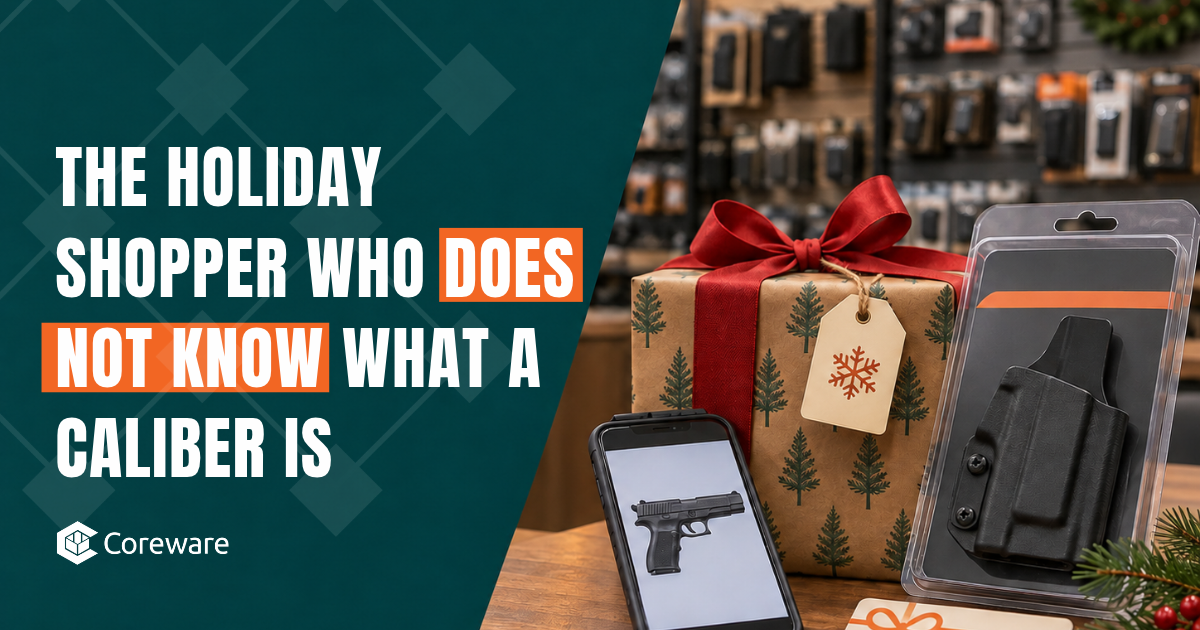
Picture a Saturday morning in November at a gun counter. A woman is standing at the handgun case with a photo on her phone that she took of her husband's pistol before she left the house, because he mentioned a few weeks ago that he wanted a new holster and she would like one under the tree. She does not know the model, and she has heard the word caliber often enough to feel a little embarrassed asking what it means. Behind her, a regular is waiting with a box of ammunition he could have paid for in under a minute. The employee is doing exactly what a good employee should, asking enough questions to keep her from buying the wrong thing without making her feel lost, and ten minutes later she is still not sure, the regular is eyeing the door, and nobody in the building has done anything wrong.
Now picture her at nine o'clock that night on the store's website, typing "holster" into the search bar and scrolling past products she has no way to evaluate. She has no account, cannot tell whether she needs one, and cannot find out whether she could pick the item up in the store and have someone check it with her first, so after a few minutes she closes the tab and tells herself she will figure it out tomorrow. Nobody had to be careless for either scene to happen. The store was built, as most gun shops are, around customers who already know what they came in for, and the person buying the gift is not that customer.
The Person at the Counter May Not Be the Person Who Will Use It
Most firearms retailers can describe their regulars without much effort. Regulars know which case to walk toward, can name the model, the caliber, and usually the exact holster or magazine they need, and when they have a question it tends to be a narrow one. Gift shoppers are a different kind of visitor, and they tend to show up when everyone else does, on weekends and in the weeks before the holidays. They may be buying for a spouse, a parent, a child, or a friend who shoots, often with nothing more to go on than a photo, a half-remembered conversation, or a budget and a date on the calendar. They want to get it right, and they are fairly sure the wrong choice will be obvious the moment the gift is unwrapped.
From the store's side, a gift shopper can look like a slow transaction, but from the other side of the counter it is an effort not to get a gift wrong, and that difference changes what help looks like. The regular wants a straight answer and a short line, while the gift shopper wants someone to translate the store without making them feel they walked into a conversation they were never meant to join. If the only path a store offers is the one built for regulars, the gift shopper will either need a long stretch at the counter or leave to finish the errand somewhere that feels easier.
The Long Conversation at the Counter Is Still a Sale
Once you have watched a few of those conversations run long, it is tempting to treat the gift shopper as the reason the line got slow. That is not really what is happening. The gift shopper came in to buy something, and the conversation runs long because the store is asking for a regular's decision from someone with a visitor's information. Say, for the sake of example, that on a Saturday in December your counter helps six people who are clearly buying for someone else, and each conversation takes ten or fifteen minutes instead of two or three. That is a real piece of the day, but it is not time you would want to save by hurrying anyone into the wrong holster, even with a regular still waiting and the employee trying to handle both at once.
The aim is not to rush gift shoppers out of the store but to give employees a few next steps that do not depend on turning a partial description into a perfect product choice on the spot. If the original firearm was bought here, the customer record may already answer the question of what fits, and if there is no safe product answer yet, a gift card, a class, or a store pickup that lets someone confirm the fit can finish the gift without asking the person at the counter to guess. None of that requires a new kind of employee so much as a path the current employee can actually use when the conversation starts to stall.
"What Fits" Is the Whole Sale
Say a shopper walks in with a photo of a compact pistol and a request for a holster, some ammunition, and maybe a case for Christmas, but cannot name the model and thinks the caliber "starts with a nine," which may be right and may not be. A knowledgeable employee can often get there anyway by asking what the firearm looks like, whether it was bought at this store, and whether the box and manual are still around. If the purchase happened here, the record of that sale may be enough. If it did not, the employee is working from a photo and a guess and will go slowly on purpose, because sending a customer home with the wrong holster or the wrong ammunition is worse than sending them home empty-handed, and for this customer, "what fits" is not a side question that comes after picking a product but the entire reason for the visit.
The same thing happens on the website, only without the employee. A gift shopper types "9mm holster" or "ammo for a Glock" and gets a list with filters that mean nothing to them and no way to tell whether the item will work. A page that assumes the shopper already knows the firearm makes perfect sense to your regulars and very little to anyone else, so what this shopper needs is not a new department but a few answers a gift buyer can actually use: whether you can look up a prior purchase, whether a gift card is available if there is no safe product answer today, whether the item can be picked up in the store and checked for fit, and whether a class or another gift that does not depend on guessing the firearm is even offered. If those answers live only in one employee's head, the next gift shopper gets a different experience depending on who is standing behind the counter.
A Gift Card Is Not a Consolation Prize
Retailers sometimes treat a gift card as the thing you offer when the sale has already slipped away, but for a gift shopper who does not know the firearm, it can be the most careful purchase in the store. The shopper does not have to guess the holster, the caliber, or a gun they have only seen in a photo, and the person who will actually use the gift can come in later, with time to choose, and put the card toward what they actually need. The card does not replace a well-run counter; it gives the shopper who cannot yet make a safe product decision an honest way to complete the gift anyway.
That only works if the gift card is easy to buy and easy to understand. If someone has to ask whether you even sell them, or if the only way to get one is to wait until the counter is quiet enough for a process that is not obvious, they may never ask, and if the website mentions every firearm on the shelf and never mentions a gift card, the after-hours shopper has no path at all. A store looking for a better way to handle this should look for a system that already treats gift cards and store credit as ordinary ways to pay, and that makes a gift card as easy to find, in the building and on the site, as the other things the store already offers.
The Website Has to Make Sense to Someone Who Does Not Shop There
Your regulars will forgive a website that assumes they already know you, but a gift shopper will not, because this may be their first and only visit to the site, late at night, trying to finish one errand before bed. Gift shoppers may not want to create an account just to buy a gift, may want to pick the item up so an employee can look at it with them, and will want a confirmation email that says plainly what happens next. If checkout is built only for people who already have a login and a familiar cart, it feels like paperwork for a store they do not belong to. A retailer looking at this should look for a website that can check out a guest without an account, send a confirmation email, and offer store pickup alongside shipping, so the first visit does not require becoming a regular first. Those are ordinary capabilities, and they change the after-hours version of the scene at the counter.
To put rough numbers on it, imagine twenty people find your website in a given week because they are buying a gift. If twelve leave before checkout because they cannot tell whether pickup is allowed, whether they need an account, or whether a gift card exists, those twelve never show up on a sales report, and you only see the eight who already knew how to finish. Your building will still do much of this work in person, but the website has to stop losing the people who start the errand after you close.
A Class Can Be the Gift
Not every good gift in a gun shop or range has to be a product hanging on a peg. A class has a date, a place, and a purpose, and buying one does not require knowing a caliber. For someone who has been meaning to get more training, or someone about to shoot for the first time, it can be a better gift than a holster chosen by a person who has never worn one, and it brings that customer back through your door on a scheduled day, which a box on a shelf cannot do.
That only works if a gift shopper can find the class, understand it, register, and pay without a string of phone calls. A retailer that already offers training should look for a way to create classes with capacity limits, pricing, location, and prerequisites, let people register and pay online in advance, send automatic confirmations and reminders, and keep attendance and training history on the customer record so the relationship does not end when the class does. None of that turns the shop into a school, but if you already offer training, holiday shoppers may be among the people looking for it, as long as they can see it.
Try It for One Week
You do not need to rebuild the store to see how this plays out in your building. For one week, pay attention to every customer who is clearly buying for someone else: the questions they ask, how long those conversations take, where they stall, and whether the employee has a clear next step when there is no safe product answer yet. Then go home, open your website as if you had never been there, and try to do the same errand without asking a colleague for help.
You may find the counter handles this better than you thought and the website is where gift shoppers disappear, or the opposite, or that gift cards sit in a drawer and nowhere in public view while classes are offered only to people who know to ask. Whatever you find, you will have walked it once the way a gift shopper would. Regulars will always find their way to the counter, but the people buying gifts are hoping you will meet them a little sooner than that.
At Coreware, we build point-of-sale and eCommerce software for firearms retailers and ranges, and much of what a gift shopper needs is already part of it. Our platform accepts gift cards, store credit, and split payments, checks out guests without requiring an account, sends confirmation emails, and supports both shipping and in-store pickup. Stores and ranges can also create classes, take registration and payment online, send automatic reminders, and keep training history on each customer's record. To learn more, visit coreware.com.