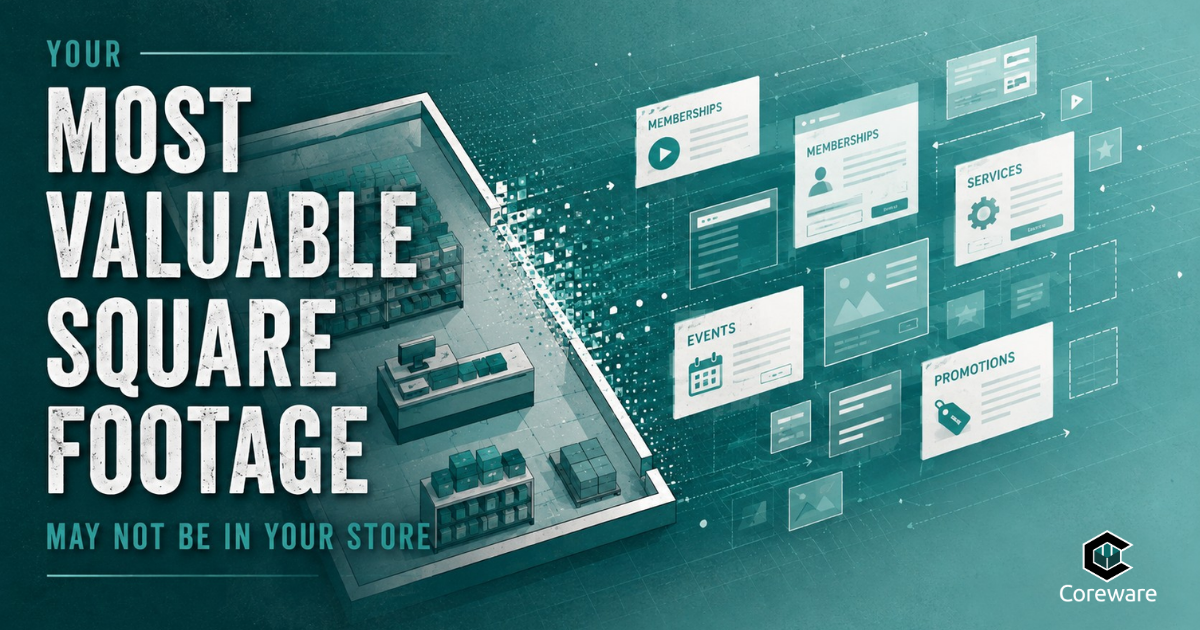
Your Most Valuable Square Footage May Not Be in Your Store
Every retailer understands the value of square footage because you pay for it every month whether it produces revenue or not. You heat it, cool it, insure it, clean it, secure it, and fill it with inventory. Every display case, counter, office, storage area, classroom, and aisle competes for the same finite amount of space, which is why good retailers pay attention to what that space is producing.
A section of the store that generates strong revenue deserves to be protected, while an area that produces very little deserves scrutiny. Inventory that sits in prime retail space for months without moving is costing more than the price paid for the product because it is also occupying space that could be producing something else. Physical retail constantly forces those kinds of decisions because there is only so much room to work with.
Your website changes that equation because it gives you another kind of square footage, and unlike your building, that space is nearly unlimited. You can create room for classes, memberships, services, events, educational programs, specialty offerings, promotions, and ideas you have not even thought of yet without removing a display case, expanding the building, or signing a lease for another thousand square feet. That is where I think a lot of retailers are leaving opportunity on the table.
Your Website Can Be More Than a Catalog
Most retailers naturally build their websites around the same basic idea as their stores. Here are the products we sell, here are our hours, here is our address, and here is how to contact us. Maybe there is an About Us page, a banner for the current promotion, and a few other things customers may need.
There is nothing wrong with any of that, but it limits the website to being a digital version of the physical store when it can be much more useful than that. Your building may have 3,000 or 5,000 square feet, but your website effectively gives you as much room as you are willing to use. That means an idea does not have to earn physical floor space before you can find out whether customers are interested in it.
Imagine that customers occasionally ask about basic handgun instruction. Maybe you have someone on staff who can teach it, or you know a local instructor who could. You believe there might be demand, but you are not certain enough to start rearranging schedules, buying equipment, dedicating classroom space, and planning a full calendar of classes.
You do not have to make all of those decisions first. You can put the class on your website, explain what it would include, identify who it is designed for, give customers a way to express interest, and then promote the idea to the people most likely to attend. If twenty-five people respond, you have learned something useful. If two people respond, you have also learned something useful, and you learned it before putting much money or time into the idea.
Digital Space Makes Experimentation Cheaper
One of the biggest challenges small businesses face is that experimentation can be expensive. A large company can try something, spend money on it, discover that nobody wants it, and absorb the mistake. A small retailer may feel that mistake for months through reduced cash flow, unused inventory, wasted labor, or valuable space committed to something that never gained traction.
Digital space makes some of those experiments much cheaper because you can test the idea before building the entire operation behind it. A retailer could explore interest in first-aid instruction, concealed carry education, private training, hunting seminars, optics workshops, cleaning clinics, specialty events, memberships, or other services that fit the business. The point is not that every retailer should offer every one of those things, it’s that you can put ideas in front of customers and let their response help determine which ones deserve further investment.
Think about how different that is from sitting around a table debating what customers might want. Businesses do this all the time, with one person convinced a membership would work, another believing customers would pay for a certain class, and someone else sure an event would draw traffic. Those ideas may be worth exploring, but until you put them in front of actual customers and measure the response, they are still guesses.
Your website, customer list, and marketing channels give you a way to turn those guesses into experiments. You can present an idea, communicate it to the right people, measure the response, and then decide whether it deserves more attention. That process lowers the cost of being wrong, which should make a business more willing to explore new opportunities.
Look at What You Already Have
Retailers looking for growth often start by asking what else they can sell. That usually leads back to more firearms, more ammunition, more accessories, or another product category. Those things obviously matter, but there may also be revenue hiding inside resources the business already has.
You have knowledge, relationships, customers, employees, and access to people with specialized expertise. You may have instructors, hunters, competitive shooters, gunsmiths, first responders, armorers, or other knowledgeable people already connected to the business. Your employees answer questions every day that customers clearly value enough to ask, and some of those repeated questions may be pointing toward something people would pay to learn in a more structured setting.
Maybe someone on your team knows optics extremely well and could conduct an evening workshop. Perhaps you know an EMT who would be interested in teaching a first-aid course once a month. Maybe customers are constantly asking about maintenance and cleaning, which could become a clinic or event. A retailer without a range might experiment with a membership built around special events, periodic services, early access to certain offers, or other benefits that make sense for that store and its customers.
None of those ideas is guaranteed to work, and that is exactly why the ability to test them matters. You are trying to discover where customer interest exists before committing heavily to the idea.
Your Customer List Is More Than a Marketing List
Retailers sometimes look at their customer database primarily as a list of people who can receive another promotional email. There is another way to look at it. Those customers can also become one of the best sources of information you have about what the business should try next.
Instead of spending months building a membership program because somebody believes customers will want it, present the idea first and see what happens. Before committing to a full calendar of classes, test one concept with people who live close enough to attend. Before launching a new service, put it in front of the customers most likely to need it and pay attention to their response.
The quality of that experiment becomes even better when you can target the right audience. A local introductory handgun class probably does not need to be promoted to every customer you have ever served. A hunting seminar may be more relevant to customers who have purchased hunting products, while an optics workshop may be particularly interesting to customers who have purchased rifles but never bought optics from you.
The better you become at matching an idea with the people most likely to care about it, the more useful the response becomes. You are no longer simply sending marketing. You are learning where demand may exist inside your own customer base.
Some of Your Best Ideas Should Fail
There is a tendency in business to judge an idea only by whether it succeeds. That can make owners hesitant to experiment because every new initiative begins to feel like something that has to work.
A better goal may be to create more inexpensive experiments and accept that many of them will go nowhere. You might test ten ideas and discover that eight generate almost no interest. That does not necessarily mean the process failed because those eight experiments prevented you from making eight larger investments based on assumptions.
The other two ideas may produce a completely different response, with a class generating far more interest than expected, a membership concept prompting customers to ask when they can sign up, or an event that seemed like a minor experiment attracting enough attention to become something worth repeating every quarter.
Those are the signals you are looking for. You want customers to help tell you where additional investment makes sense instead of building everything first and hoping the demand appears afterward.
A retailer with limited people, money, and time cannot afford to chase every opportunity, but that same retailer also cannot afford to stop experimenting. Making those experiments smaller, cheaper, and easier to measure gives the business a way to keep looking for growth without betting heavily on every idea.
Start Thinking About Digital Square Footage
Retailers already know how to walk through their stores and evaluate physical space. They can see the rack that barely moves, the display that generates constant attention, the counter that is always crowded, and the corner of the building that could probably be used better.
Your website deserves that same level of thought, but the question is different. Instead of asking what every square foot is currently producing, ask what the digital space allows you to try that would be difficult, expensive, or risky to test physically.
There may be classes your customers would attend, services they would buy, memberships they would join, events they would support, or partnerships that could create an entirely new revenue stream. You may already have the people, knowledge, customer relationships, and expertise required to make those opportunities work. What you need first is a practical way to put the idea in front of customers and find out whether they care.
That is one of the directions we are building toward at Coreware. The Coreware platform brings together websites, customer information, forms, email marketing, classes, events, memberships, and other tools that can help retailers turn an idea into something they can actually test with their customers. We want retailers to be able to use the resources they already have to discover new opportunities, measure the response, and invest more confidently in the ideas that show real potential.
Your building will always have walls. Your digital storefront does not have to.
Visit coreware.com to learn more.
.png)
.png)
.png)
.png)
.png)
.png)